


The Swing Of Things Now
Getting back into the swing of things wasn't about returning to the past or forcing a rhythm that didn't exist. It was about cleaning the gears, oiling the pivots, and trusting the weight to pull you forward.
The heavy oak door of the clockmaker’s shop clicked shut, and for a moment, Elias stood in the sudden, rhythmic silence. It wasn’t a true silence, of course. It was a chorus of a thousand different heartbeats, all made of brass and steel. Some were frantic ticks, others were slow, sonorous gongs, but they all lived within the same physics.
He began to clean the pallets, scraping away the dried, gummy oil that had turned into a microscopic sludge. He polished the teeth of the escape wheel until they shone like gold. He was meticulous. If the friction was too high, the swing died. If the friction was too low, the clock raced toward a future it wasn't ready for. The Swing of Things
His own life had felt out of beat lately. Since Martha died, the house felt like a clock with a snapped mainspring. He would wake up at four in the morning, find himself standing in the kitchen with a kettle that hadn't been filled, wondering what the next movement was supposed to be. People told him he just needed to get back into the swing of things, as if life were a jump rope he could simply hop back into. But Elias knew that swinging required a pivot point.
Elias leaned back, rubbing his eyes. He realized he had been holding his breath. The steady, hypnotic pulse of the machine filled the room, and for the first time in months, the frantic ticking in his own chest seemed to settle. Getting back into the swing of things wasn't
In the workshop, "the swing" wasn’t a metaphor. It was the escapement. It was the precise arc of a pendulum that dictated whether a second was a second or a lie. He walked to his workbench, his movements stiff from a winter chill that had settled into his joints. He sat down, pulled the loupe over his eye, and looked into the guts of a 19th-century longcase clock.
It had arrived yesterday, silent and stubborn. The owner said it had simply "given up" after her father passed away. Elias knew better. Clocks didn’t have grief, but they had gravity, and gravity was a patient thief. It wasn’t a true silence, of course
He adjusted the crutch of the longcase clock, a tiny, forceful bend of the metal. He pushed the pendulum again. Tick. Tick. Tick. Tick. Even. Perfect. The swing was restored.
The Listening Walk
In this children’s book, a young girl takes a quiet walk with her father and identifies the many different sounds they hear.

Family Activity: A Tree’s Life
Examine a tree’s lifecycle and find similarities to lifecycles of other living things.
Why Teach Outside?
Nature helps children’s development–intellectually, emotionally, socially, spiritually, and physically. Studies show that teaching outdoors produces student gains in social studies, science, language arts and math.
Environmental Education Activity Guide
96 hands-on, multi-disciplinary activities make teaching fun! Aligned with state and national standards, our practical and flexible lesson plans engage students in learning.
MAKE LEARNING FUN
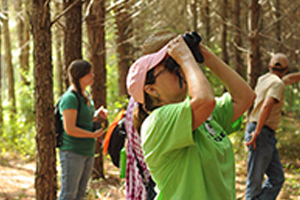
Get our educational materials and professional development by participating in an in-person workshop or an online course.
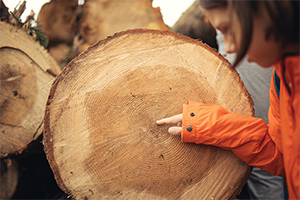
Get information relevant to your state, plus local assistance and connections to resources and professionals in your community.
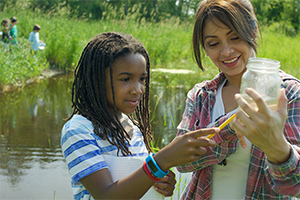
Get a wealth of up-to-date resources, support, and ideas from teachers and other educators.

Jess Kaknevicius
SUBSCRIBE TO OUR NEWSLETTER, The Branch
Sign up for our monthly e-newsletter for free tools and resources, new lesson plans, professional development and grant opportunities, and tips from educators for teaching about the environment.